





Most UK businesses need a dedicated HR hire between 30 and 50 employees, although the trigger is often rising complexity rather than headcount alone. Employee relations, recruitment volume and compliance demands can signal the need for HR earlier, particularly in higher-risk sectors such as care and manufacturing.
How to Structure Your HR Department as Your Business Grows
Build an HR department that scales with your business. Explore key roles, team structures, staffing ratios and practical guidance for UK employers. [17 Min Read]
Table Of Content
An effective HR department does far more than manage recruitment and paperwork. It shapes how your business hires, retains talent, stays compliant and scales sustainably. Yet one of the most common mistakes growing organisations make is building their HR function either too late or in the wrong order. The result is often inconsistent processes, rising employment risk, unnecessary costs and a poor employee experience.
There is no single HR department structure that works for every business. The right model depends on your size, growth stage, hiring plans, organisational complexity and long-term objectives.
Knowing you need HR support is one thing. Knowing which roles to hire, when to hire them and how to organise your HR department as your workforce grows from 15 to more than 500 employees is what enables sustainable growth and avoids costly mistakes. Businesses that align their HR structure with their stage of growth are better equipped to manage compliance, support managers and create the foundations for sustainable growth.
This guide explains how to structure your HR department at every stage of business growth. You’ll learn which HR roles and responsibilities matter most, when to hire your first HR professional, how to choose between generalist and specialist HR models, appropriate HR-to-employee ratios, and how to organise HR teams across multiple locations.
By the end, you’ll have a practical framework for building an HR function that supports both your current needs and future growth.
Key Takeaways
- HR department structure should follow headcount, complexity and risk – not a fixed template. A 50-person firm and a 250-person firm need fundamentally different models.
- Your first HR hire is usually a generalist, not a specialist. The seniority of that hire depends on whether you need strategy, operations, or both.
- Typical staffing benchmarks sit around one HR professional per 60 employees (CIPD), though digital maturity and devolved line-management can stretch this considerably.
- UK salary expectations in 2026 vary widely: HR Administrators from approximately £26,000, HR Advisors around £35,000 – £45,000, HR Managers commonly £45,000 – £65,000-plus and HR Directors frequently £70,000 – £100,000-plus.
- The Employment Rights Act 2025 raises the compliance bar, making credible HR leadership more important for businesses of every size.
- Multi-site and PE-backed businesses need deliberate decisions about centralised versus devolved HR before scaling.
In This Guide
What Is an HR Department Structure?
An HR department structure is the framework that defines how your human resources function is organised. It determines which HR roles exist, who is responsible for key activities such as recruitment, employee relations, learning and development, compliance and workforce planning, and how those roles report into the wider business.
An effective HR department structure ensures the right people are responsible for the right work at the right stage of business growth. It aligns HR capability with the organisation’s size, complexity, commercial objectives and legal responsibilities, helping the business operate efficiently while supporting employees throughout the employment lifecycle.
In practice, an HR organisational structure does three jobs. It establishes clear accountability so responsibilities are not overlooked. It determines the level of expertise and investment required within the HR function. And it positions HR as either an administrative support service or a strategic partner that helps drive business performance.
There is no universal HR department structure that every organisation should follow. A growing business with 30 employees has very different priorities from a national employer with 300 or 3,000 people. While a smaller organisation may operate effectively with an experienced HR Manager or a part-time HR hire supported by outsourced payroll, a larger business may require an HR Director, HR Business Partners, specialist recruiters, employee relations expertise and dedicated learning and development professionals.
The best HR structure is the one that reflects your organisation’s current needs while providing room to grow. The right answer always depends on context, which is why this guide is organised by company size rather than offering one fixed model.
Why Your HR Department Structure Matters
Your HR department structure directly affects how effectively you recruit, retain and develop employees, manage legal risk, support managers and scale the business. It is not simply an organisational chart. It is a commercial decision that influences productivity, compliance and organisational resilience.
When HR responsibilities are unclear or concentrated in the wrong roles, recruitment slows, managers lack support and employee relations and compliance issues become harder to manage. As your organisation grows, the need for the right HR capability becomes increasingly important for three reasons:
Employment law is becoming more complex
UK employers face one of the most significant periods of employment law reform in recent years. The Employment Rights Act 2025 received Royal Assent in December 2025, with major provisions being introduced across 2026 and 2027. As these changes take effect, businesses need appropriate HR expertise to manage changing obligations, support managers and reduce employment risk.
A tighter talent market
Recruiting and retaining skilled employees remains challenging across many sectors. According to the CIPD, around one-third of UK employers continue to report hard-to-fill vacancies. Effective HR now requires more than administration. Businesses need the capability to attract talent, improve employee experience and support managers throughout the employment lifecycle.
HR has become a strategic business function
HR has evolved beyond recruitment, contracts and policies. It increasingly supports governance, workforce planning, leadership, risk management and sustainable growth. As your organisation grows, your HR structure should evolve with it, balancing operational delivery with the strategic capability needed for the next stage of business growth.
The right HR structure is therefore not about building the largest possible team. It is about introducing the right expertise at the right time, based on your headcount, complexity, risk and growth plans.
The Core HR Roles and Responsibilities
Every HR department is built around a core set of roles, but not every organisation needs them all from day one. The biggest mistake growing businesses make is hiring HR roles too early, too late or at the wrong level of seniority. Building an effective HR function means introducing the right expertise at the right stage of growth.
The core HR roles and responsibilities span four broad levels: administrative support, advisory, management and strategic leadership. As a business grows, it typically adds roles from the bottom up, then layers in specialists. Understanding the responsibilities, seniority and cost of each HR role is essential when designing an HR department structure that supports sustainable business growth.
The table below summarises the main HR roles in the UK, their primary responsibilities and typical salary ranges for 2026. Salary levels vary according to sector, location, organisational size and experience, with London and financial services generally attracting higher pay.
| Role | Primary focus | Typical UK salary range (2026) |
| HR Administrator / Assistant | Data, contracts, records, basic queries | £26,000 – £30,000 |
| HR Advisor | Day-to-day ER cases, policy, line-manager support | £35,000 – £45,000 |
| HR Business Partner | Embedded strategic support to a business unit | £55,000 – £80,000+ |
| HR Manager | Operational leadership of the HR function | £45,000 – £65,000+ |
| HR Director / Chief People Officer | Strategy, board-level people leadership | £70,000 – £100,000+ |
These figures are UK-wide averages. Salaries vary by region, sector, and the specific demands of the role. For regional differences, see our salary guide, which breaks down average salaries by region.
Understanding the differences between key HR roles
While these job titles are sometimes used interchangeably, they serve very different purposes. Choosing the wrong level of HR expertise can lead to capability gaps, unnecessary costs or both.
- HR Advisor vs HR Manager. An HR Advisor provides hands-on support with employee relations, policies and manager guidance. An HR Manager takes ownership of the entire HR function, oversees priorities and is often responsible for leading the HR team. A manager owns the function, manages a team and sets operational priorities.
- HR Manager vs HR Business Partner. An HR Manager typically oversees day-to-day HR operations across the organisation, while an HR Business Partner works strategically with senior leaders to align people strategy with business objectives. Our guide to HR Business Partner vs HR Manager explores these differences in greater detail.
- HR Manager vs HR Director. An HR Manager is responsible for operational delivery, while an HR Director or Chief People Officer shapes long-term people strategy, advises senior leadership and influences organisational direction. As businesses grow, many require both operational and strategic HR leadership, as covered in when do you need both an HR Manager and HR Director.
Specialist HR roles, including recruitment, learning and development, reward, HR systems and people analytics, are usually introduced once business size and organisational complexity justify dedicated expertise rather than relying on a single generalist.
The most effective HR departments do not add roles simply because other organisations have them. They build capability in line with business needs, ensuring every HR appointment delivers measurable value.
How to Structure Your HR Department by Company Size
One of the most common questions business leaders ask is: How many HR staff do I need? In our experience placing HR leaders across UK SMEs, the need for additional HR support is often driven by employee-relations complexity, growth plans and organisational risk rather than headcount alone. There is no fixed HR-to-employee ratio that works for every business, but clear patterns emerge as organisations grow and their HR needs become more complex.
Smaller businesses often benefit from broad HR generalists and outsourced specialist support, while larger organisations typically need layered teams with dedicated expertise. For smaller businesses, the first HR hire does not always need to be full-time. A part-time HR hire can provide the right level of support as the business grows. Hiring too late increases compliance risk and places unnecessary pressure on managers, while hiring too early can create avoidable overhead.
As a practical guide, many organisations introduce their first dedicated HR professional between 30 and 50 employees, establish a structured HR team at around 100 employees and build a specialist HR department once headcount exceeds 250. The recommendations below provide a useful framework for assessing your HR needs, rather than fixed thresholds.
Startups and small SMEs (under 50 employees)
Below around 30 employees, many businesses manage HR through an office manager, the finance team or outsourced support. A practical starting point is to consider a first dedicated HR hire at around 30 to 50 employees, although factors such as organisational complexity, sector and risk may mean hiring earlier or later. This is the point at which a first dedicated HR hire, typically a capable HR Generalist or HR Manager, pays for itself by removing risk and freeing leadership time.
At this stage, a lean structure is usually the most effective. One experienced generalist supported by outsourced payroll and specialist employment law advice is often sufficient. Our guide on the essential roles in a small HR team explains how to prioritise HR capability when resources are limited.
Growing businesses (around 50 employees)
At roughly 50 employees, HR needs a clear owner. Most businesses appoint an HR Manager who runs the function end to end, often as a team of one or with junior administrative support. The focus also changes. HR moves beyond day-to-day administration to establish consistent processes, improve employee relations, coach line managers and introduce workforce planning.
At this stage, HR should no longer be viewed as an administrative necessity. It becomes an operational function that supports sustainable business growth. For a detailed model at this stage, see our guide to HR structure for 50 employees.
Established SMEs (around 100 employees)
At around 100 employees, relying on a single HR professional becomes increasingly difficult. Greater organisational complexity, higher recruitment volumes and more employee relations activity usually require additional support.
A common structure is an HR Manager leading one or two HR Advisors or administrators, with recruitment either in-house or handled by a specialist agency. Some businesses at this point begin considering whether they need strategic leadership above the manager level. Our dedicated guide to HR structure for 100 employees explores the options.
Mid-market and larger businesses (250+ employees)
Beyond 250 employees, HR typically becomes a full department led by an HR Director or Chief People Officer. Reporting into that leadership team are often HR Business Partners aligned to business units, alongside specialists responsible for recruitment, reward, learning and development, HR systems and people analytics. Businesses at this size should also monitor proposed changes around ethnicity and disability pay gap reporting. See our guide to HR structure for 250+ employees for a full breakdown.
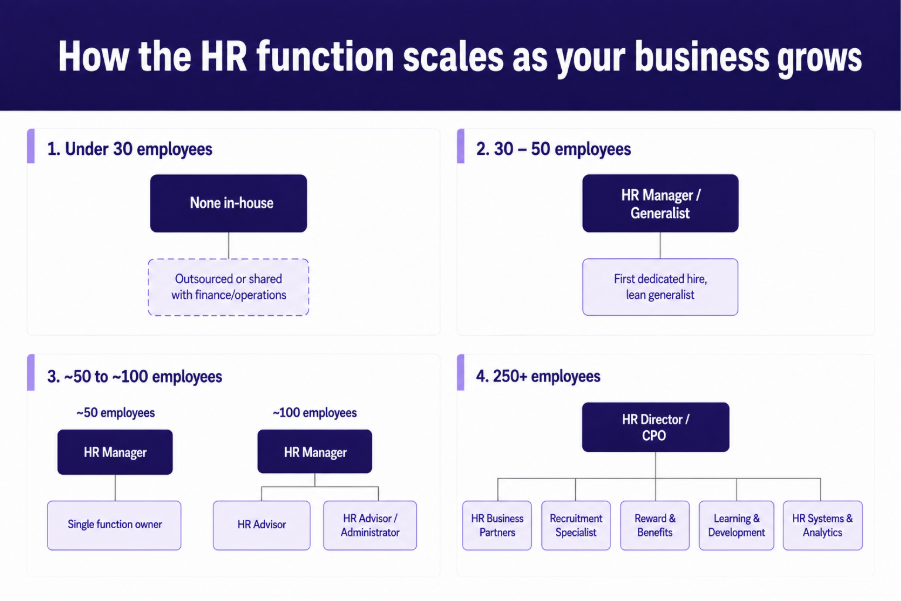
| Company size | Typical HR structure | Likely lead role |
| Under 30 | Outsourced or shared with finance/operations | None in-house |
| 30 – 50 | First dedicated hire, lean generalist | HR Manager / Generalist |
| ~50 | Single function owner | HR Manager |
| ~100 | Small team: manager plus advisors/admin | HR Manager |
| 250+ | Full department with specialists | HR Director / CPO |
These headcount bands are intended as practical guidance rather than fixed rules. The right HR department structure depends on factors such as regulatory requirements, workforce complexity, geographical spread and growth ambitions. Businesses operating in highly regulated sectors, including manufacturing, healthcare and social care, often require stronger HR capability much earlier than organisations of a similar size in lower-risk industries.
HR Organisation Chart Examples by Company Size
The HR Organisation Chart below shows how HR structures can typically evolve as a business grows, with roles and reporting lines becoming more specialised at each stage.
Choosing Your First HR Hire: Director or Manager?
Your first senior HR hire should match the problem you are solving. If you need someone to build processes, run recruitment and handle day-to-day employee relations, an HR Manager is usually right. If you need strategic people leadership at board level, including culture, organisational design and business transformation, an HR Director is usually the better fit.
For most organisations with fewer than 100 employees, an experienced HR Manager is the most appropriate first senior HR hire. An HR Manager establishes processes, supports managers, improves recruitment, manages employee relations and creates the operational foundations for future growth. An HR Director, by contrast, leads people strategy, advises the board and helps shape organisational direction.
The most common hiring mistake is recruiting for a title rather than a business need. Appointing an HR Director on a senior salary package offers little value if the organisation primarily needs operational delivery. Equally, expecting an HR Manager to lead organisational transformation, support acquisitions or advise the board on workforce strategy is likely to stretch the role beyond its intended scope.
Before deciding, ask yourself three practical questions:
- What is the dominant need – strategy or delivery? Delivery points to a manager; strategy points to a director.
- Who will this person report to and influence? Board-level influence usually requires director-level credibility.
- What is the next 24 months likely to demand? Rapid scaling, restructuring or investor scrutiny often justifies senior capability sooner.
A well-timed appointment creates the foundation for sustainable growth, while the wrong hire can increase costs without addressing the challenges the business actually faces. In our experience recruiting HR leaders across the UK, the businesses that get this right are clear about the problem before they fix on a job title.
For a more detailed comparison, including hybrid options such as an interim or fractional HR Director, see our guides on whether to hire an HR Director or HR Manager first.
Generalist vs Specialist HR Team Structures
Generalist HR structures rely on broad HR professionals who manage a wide range of responsibilities across recruitment, employee relations, policies, performance management and compliance. Specialist HR structures, by contrast, divide work into dedicated functions such as talent acquisition, reward, learning and development and HR systems.
The right model depends on your organisation’s size, complexity and business priorities rather than a fixed headcount. Most organisations begin with generalists because they provide flexibility and broad operational coverage. As workforce size and organisational complexity increase, however, specialist expertise becomes increasingly valuable.
For most small and medium-sized businesses, a generalist HR team offers the best balance of flexibility, capability and cost. Specialisation makes sense once volume in a given area justifies a dedicated expert, typically beyond 150-250 employees.
The comparison below highlights the key differences.
| Factor | Generalist structure | Specialist structure |
| Best for | Smaller and growing businesses | Larger or complex organisations |
| Flexibility | High – one person covers many areas | Lower – defined remits |
| Depth of expertise | Broad but shallower | Deep in each function |
| Cost efficiency | Strong at low headcount | Justified at scale |
| Risk | Capacity bottlenecks, key-person risk | Coordination overhead, silos |
The decision is rarely a choice between one model or the other. Many growing organisations adopt a hybrid approach that combines the strengths of both.
A common example is an HR team made up of HR Business Partners who work closely with business leaders, supported by specialists responsible for recruitment, reward, learning and development, HR systems and people analytics. This model allows HR Business Partners to focus on strategic support while drawing on specialist expertise when required. If you’re unsure when to introduce an HR Business Partner, read our guide on when you should hire an HR Business Partner to understand the signs your organisation is ready for the role.
For many organisations, a hybrid HR structure delivers the best of both worlds by combining commercial partnership with technical expertise. Our guide to HR generalist vs specialist team structures examines how to design that balance as you grow.
Getting the HR-to-Employee Ratio Right
There is no universal HR-to-employee ratio, but common benchmarks offer a useful starting point. CIPD research suggests that many UK organisations operate with approximately one HR professional for every 60 employees, while other industry benchmarks indicate around 1.5 HR professionals per 100 employees. These figures should be treated as guidance rather than fixed rules, as HR requirements vary significantly between organisations. The right ratio depends on your organisation’s size, complexity and people strategy, not headcount alone.
Several factors influence the size of the HR team required:
- Higher HR capacity is often needed in organisations with complex employee relations, unionised workforces, high staff turnover, regulated industries or periods of rapid growth and organisational change.
- Lower HR capacity may be appropriate where organisations have mature HR technology, self-service systems, stable workforces and experienced line managers who take ownership of day-to-day people management.
An HR team that appears efficient on paper may be overstretched in practice, leaving little capacity for workforce planning, leadership development, employee engagement or organisational improvement.
Use HR-to-employee ratios as a benchmark, not a target. The right HR department structure is one that gives your team the capacity to support today’s workforce while preparing the business for future growth. Our guide to the ideal HR-to-employee ratio explains how to benchmark your HR function and determine the right level of HR resource for your organisation.
Structuring HR for Multi-Site and Complex Businesses
As organisations expand across multiple locations, business units or legal entities, their HR structure becomes significantly more complex. What works for a single-site business rarely provides the consistency, governance or local support required across a distributed organisation.
For most multi-site organisations, the most effective approach is a hybrid model. A central HR team is responsible for people strategy, policies, governance and compliance, while HR Business Partners or HR Advisors provide local support to individual sites or regions. This structure balances central control with the flexibility needed to respond to local operational challenges.
The right model depends on several factors, including the number of sites, geographical spread, workforce size, regulatory requirements and the level of autonomy each location requires.
Complexity comes from more than geography. Private equity-backed businesses, groups built through acquisition, and organisations spanning different sectors all add layers that a single-site structure cannot absorb.
In these settings, three challenges are particularly common:
- Balancing consistency with local flexibility. Organisation-wide policies, governance and reporting must be applied consistently while giving local managers the flexibility to respond to operational needs.
- Providing effective on-site support. Multi-site HR roles frequently involve regular travel and close collaboration with local leadership teams to maintain visibility, build relationships and resolve employee issues before they escalate.
- Integration. Mergers and acquisitions often require the alignment of employment terms, HR systems, policies and organisational culture, making HR a critical part of successful business integration.
For investor-backed and high-growth organisations, the quality of the HR function can directly influence business performance and enterprise value. A credible people function reduces risk and supports the growth thesis. Our guide to structuring HR for multi-site businesses explores the most effective operating models for organisations managing multiple locations, business units or acquired companies.
Common HR Structure Mistakes to Avoid
The most common HR structure mistakes include hiring too late, appointing the wrong level of seniority and treating HR as a purely administrative function. These decisions can increase compliance risk, hinder growth and place unnecessary pressure on leaders and managers.
Successful organisations build their HR capability proactively rather than waiting for people problems to force change. Avoiding the following mistakes can help create a stronger, more scalable HR function.
- Hiring too late. Waiting until a crisis forces the issue means hiring under pressure, often into the wrong shape of role. Introducing HR capability before problems escalate is almost always more cost effective than reacting to a crisis.
- Buying the wrong seniority. A common mistake is choosing a job title instead of the capability the business actually needs. A director where a manager is needed wastes budget; a manager where a director is needed leaves strategy unowned.
- Under-resourcing the function. As headcount increases, expecting a single generalist to manage recruitment, employee relations, compliance, performance management and strategic planning inevitably creates bottlenecks. HR capacity should grow alongside organisational complexity, not simply employee numbers.
- Ignoring sector context. Headcount is only one factor when designing an HR department structure. Care, manufacturing and other higher-risk sectors need stronger HR capability earlier than headcount alone suggests.
- Treating HR as an administrative function. Modern HR extends far beyond contracts, policies and payroll administration. Organisations that view HR purely as an administrative service often miss opportunities to improve leadership capability, employee engagement, workforce planning and organisational performance.
Getting your HR department structure right is not about adding more people. It is about ensuring the right expertise is in place at the right time to support your organisation’s objectives.
Conclusion
There is no one-size-fits-all HR department structure. The best HR functions evolve alongside the business, adding the right capability at the right time. Smaller organisations typically benefit from a lean HR function led by an experienced generalist, although a part-time HR hire can be a practical option where a full-time role is not yet needed. As headcount and organisational complexity increase, businesses often require dedicated HR leadership, broader operational support and, eventually, specialist roles.
The most successful organisations build their HR function deliberately, introducing the right expertise at the right time rather than reacting to problems after they arise. As compliance demands rise and the talent market tightens, the businesses that treat HR structure as a strategic decision will be best placed to grow with confidence.
When reviewing your own HR function, consider whether it is equipped to support your next stage of growth. Are responsibilities clearly defined? Do you have the right balance of operational and strategic capability? And is your HR team focused on creating long-term value rather than responding to day-to-day challenges?
Not sure whether your next hire should be an HR Manager, HR Advisor or HR Director? Speak to our specialist HR recruiters about the structure that fits your current stage and growth plans.
This is general guidance, not legal advice – for case-specific employment law decisions, consult ACAS or qualified legal counsel.



Share
FAQ
At what size should a business hire its first HR person?
What is a typical HR department structure for a 100-employee company?
A common structure for a 100-employee business is an HR Manager leading one or two HR Advisors or administrators, with recruitment handled in-house or by a specialist agency. Some businesses at this stage also bring in strategic leadership above the manager level. The exact shape depends on sector, growth rate and complexity, so the model should be tailored rather than copied.
Should I hire an HR Director or HR Manager first?
It depends on what your business needs most. If you need support with HR processes, recruitment and employee relations, an HR Manager is usually the right first hire. If you need board-level strategy, culture leadership or transformation expertise, an HR Director may be a better fit. Most businesses with fewer than 100 employees start with an HR Manager and add director-level capability as the business grows.
How many HR staff should a company have?
There is no universal HR-to-employee ratio. As a general benchmark, many UK organisations have around one HR professional for every 60 employees, but the right level depends on factors such as sector, workforce complexity, turnover and how much HR responsibility sits with line managers. Use the ratio as a starting point, not a fixed target.
What is the difference between an HR Business Partner and an HR Manager?
An HR Manager typically oversees the day-to-day HR function, including processes, employee relations and team management. An HR Business Partner works more strategically with business leaders, aligning people priorities with commercial objectives. Larger organisations may use both, with HR Managers overseeing central operations and HR Business Partners supporting specific divisions or sites.
When should payroll become part of the HR function?
Payroll often becomes part of the HR function as a business grows and payroll processes become more closely linked to employee records, benefits and compliance. For smaller businesses, payroll may remain with finance or an external provider. As headcount increases, bringing payroll into HR can improve coordination, accuracy and employee support.
How should HR be structured across multiple sites?
Most multi-site businesses use a hybrid model: a central HR team owns strategy, policy and compliance, while HR Business Partners or advisors support individual locations. The balance between centralisation and local autonomy depends on how similar and dispersed the sites are. Acquisitive and PE-backed groups should decide their operating model deliberately before scaling, to avoid inconsistency and integration problems later.
What should an HR organisation chart look like?
An HR organisation chart should reflect the size, structure and needs of the business. Smaller organisations may have one HR professional reporting directly to a senior leader, while larger businesses may have dedicated roles for areas such as recruitment, employee relations, learning and development, and payroll. The structure should remain flexible and evolve as the organisation grows.
What is the best HR department structure?
The best HR department structure depends on your organisation’s size, complexity and growth plans. Smaller businesses typically benefit from a lean generalist HR function. At an earlier stage, a part-time HR hire can be a practical option where a full-time appointment is not yet needed. Larger organisations often need HR Managers, Business Partners and specialist teams. The right structure provides the capability your business needs now while allowing the function to scale as the organisation grows.
Related Posts

June 2nd 2026
Do I Need Senior or Junior HR Support? A UK Hiring Guide
One of the most common and costly mistakes in HR hiring is choosing the wrong level, and in practice, this is where most…

May 15th 2026
HR Officer or HR Advisor: Which Is Right for Your Business?
Bringing HR in-house for the first time is a significant step, and one that often raises an immediate question. Should y…

May 6th 2026
When to Move from Outsourced to In-House HR
Many UK businesses start with outsourced HR and for good reason. When headcount is low, a retained provider offers essen…

April 24th 2026
When Should I Hire an HR Business Partner?
Many growing businesses reach a point where transactional HR is no longer enough. Core processes may be running smoothly…

April 12th 2026
Building Employee Resilience: The HR Playbook
Employee resilience has evolved from a soft skill into a critical driver of organisational stability. For HR leader…

April 8th 2026
When Should a Startup Hire Their First HR Professional?
You launched your startup to build products, win customers, and grow something meaningful. But as your team gr…